What is Dungeons & Dragons?
 Follow us
In short: Dungeons & Dragons, or DnD or D&D, is a creative tabletop role-playing game that, through improvisation and imagination, takes players on an epic journey through a fantasy world. The term tabletop literally means ‘table surface’, and in D&D it emphasizes the physical aspect of the game. Contrary to what some newcomers might think, D&D isn’t a video game (though you could say Baldur’s Gate is the digital spin-off…). Like a classic board game, players gather around a table and play using only miniatures, character sheets, and dice!
In D&D, each player uses a character sheet to create a hero with unique skills, backstory, and goals. During the adventure, players act as their characters and describe what they wish to do. The game master, known as the Dungeon Master or DM, creates and manages the game world, designs challenges and adventures, and responds to the players’ choices. The DM describes the characters' locations, narrates the consequences of their actions, and portrays all NPCs (non‑player characters) they encounter. In essence, the Dungeon Master serves as referee, storyteller, and opponent all in one!


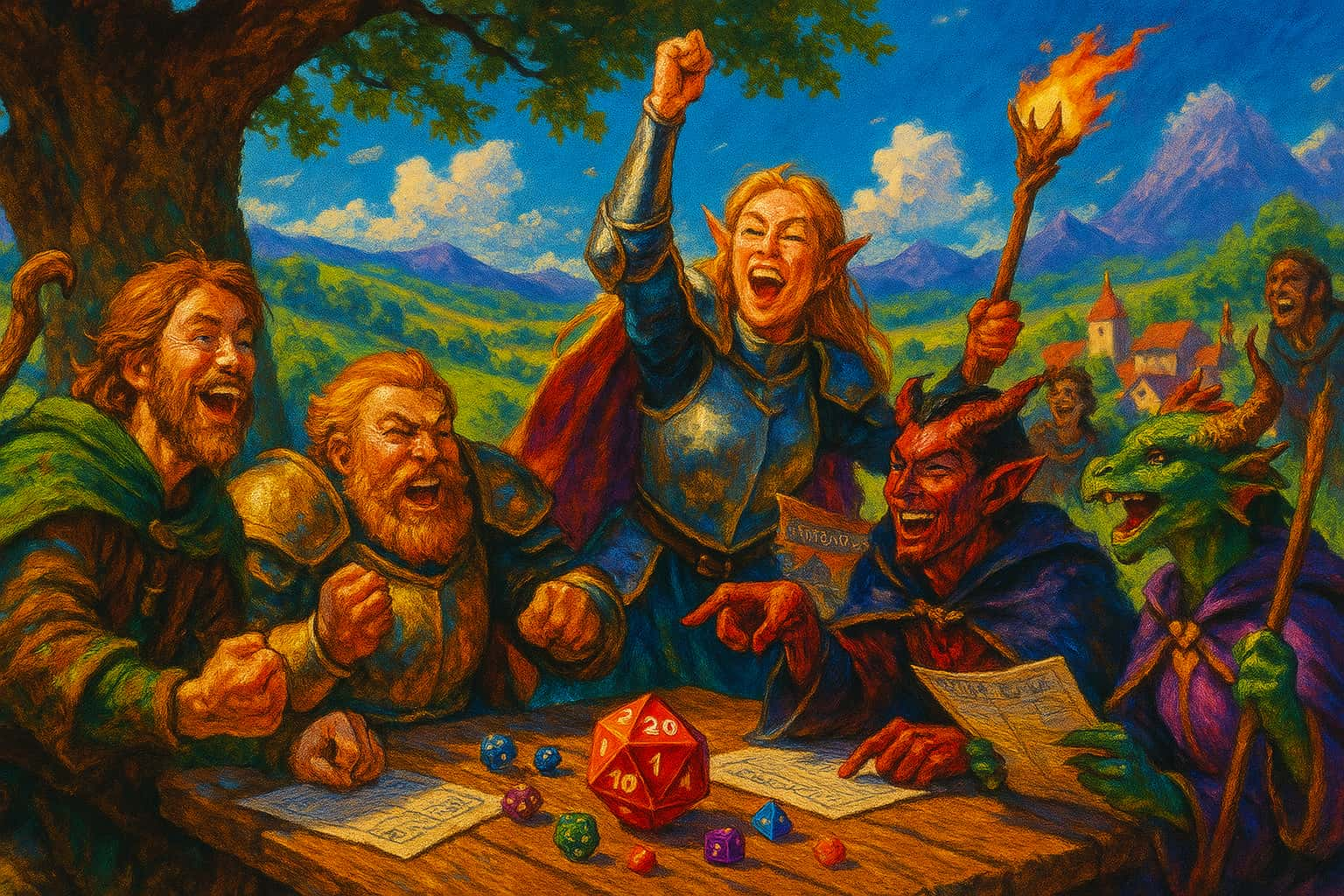
A central part of determining how the story unfolds belongs to the iconic twenty-sided die: the d20. This die decides the success of critical actions for both players and the DM, from convincing a guard of your innocence to striking an enemy with your sword or fireball. High rolls indicate success; low rolls often lead to humorous failures.
D&D is all about teamwork. Alongside your fellow players, you solve puzzles, defeat monsters, and complete quests. As the adventure unfolds, your character develops and acquires new abilities and traits, ensuring that each session is distinct. The true magic of Dungeons & Dragons lies in boundless imagination. You can attempt any action and narrate any story you envision. Whether you explore ancient ruins for treasure, negotiate peace between rival factions, or face a dragon, anything is achievable.
In summary, playing Dungeons & Dragons offers an engaging and imaginative experience where you and your friends can craft and embark on your own adventures. Ready to dive in? Keep reading!
The history of D&D
The history of D&D is as fascinating and multifaceted as the game itself. It began in 1974 when Gary Gygax and Dave Arneson, two passionate tabletop wargamers, decided to merge their love of medieval fantasy with their interest in wargaming. In three slim booklets of about 40 pages each, they created the very first edition of Dungeons & Dragons, now known as "Original D&D" or "OD&D". This groundbreaking step not only laid the foundation for the genre of tabletop role‑playing games but also introduced an entirely new form of entertainment that puts players’ imagination at the centre stage.
Over the years, D&D has evolved through several editions, each introducing its own rules and enhancements that made the game more accessible and enjoyable for a broader audience. The second edition, known as Advanced Dungeons & Dragons, was released in 1989 and brought a more structured rule set along with a deeper exploration of the game world’s lore.


The third edition, released in 2000, along with its 3.5 revision, introduced significant changes, including a new d20 System that simplified the mechanics. This also made it easier for players to customise and develop their characters, resulting in a richer, more personalised gaming experience.
The fourth edition of D&D, released in 2008, focused on tactical play and teamwork with rules that made combat more dynamic. While this edition received mixed reviews, it steered the evolution of D&D in a new direction. Some players are devoted to this version, and it even laid the groundwork for another popular tabletop game called Pathfinder!
The latest, fifth edition, released in 2014, is arguably the most successful to date. For many players, it encapsulates the essence of D&D while making the game more approachable for newcomers. With an emphasis on simplicity and flexibility, the fifth edition merges the strengths of its predecessors, offering a gameplay experience that resonates with both beginners and experienced players.
D&D has also made a lasting impact on pop culture, with references appearing in books, films, and TV series. It has inspired countless creatives and imaginative minds to craft their own worlds. The game has even shaped modern video games, particularly in the RPG genre. The acclaimed Baldur’s Gate, for instance, operates entirely on D&D mechanics and received numerous Game of the Year awards last year!
How can you begin playing D&D yourself?
Getting started with Dungeons & Dragons is simple; all you need is the Player’s Handbook, the Starter Set, and a good dose of enthusiasm. Want to learn a bit more first? No problem! We’ve written a helpful beginner’s guide that explains step by step how you can start ‘playing D&D’.

Dungeons & Dragons – 5th Edition Player's Handbook
$35.99
A guide that helps you create characters, grasp the rules, and embark on adventures in the world of D&D.

Dungeons & Dragons Starter Set
$24.40
A beginner adventure designed to help new players and Dungeon Masters grasp the fundamentals of D&D through a ready-to-play story set on Stormwreck Isle.